
Blockchain is a distributed ledger technology — a system for recording information in a way that makes it difficult or impossible to alter, hack, or cheat. A ledger is simply a list of records. What makes blockchain different is that the ledger is replicated across an entire network of computers (nodes) rather than stored on any single server.
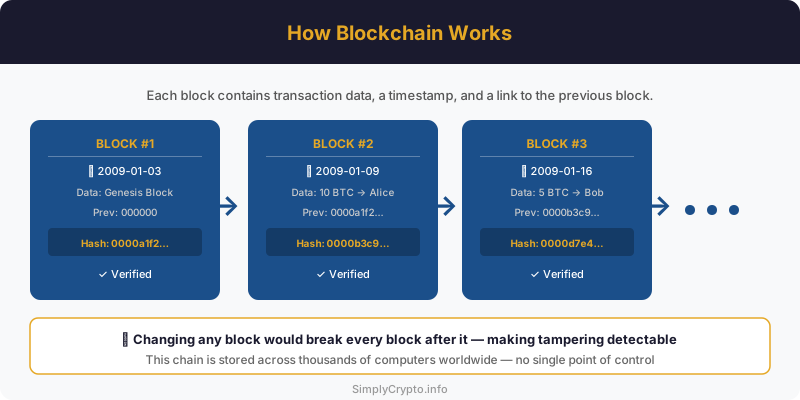
Each block in a blockchain contains three key elements: a set of transaction data, a timestamp, and a cryptographic hash of the previous block. The hash is a fixed-length string generated by a mathematical function; even a single-character change to the input produces a completely different hash. This property creates the chain's tamper-evidence — altering any historical block would invalidate the hash linkage for every subsequent block, and the network's other nodes would immediately reject the altered chain.
Consensus mechanisms are the rules by which nodes agree on which version of the ledger is correct. Bitcoin uses Proof of Work, where nodes (miners) compete to solve computationally expensive puzzles. The winner adds the next block and earns newly issued Bitcoin. This makes attacking the network extremely costly — you would need to outpace the combined computational power of the entire honest network. Ethereum transitioned to Proof of Stake in 2022, where validators lock up (stake) ETH as collateral. Dishonest validators risk losing their stake, creating economic rather than computational security.
Public blockchains like Bitcoin and Ethereum are permissionless — anyone can participate as a node or validator. Private and consortium blockchains restrict participation, sacrificing decentralisation for speed and privacy. Layer 2 scaling solutions, such as the Lightning Network for Bitcoin and rollups for Ethereum, process transactions off the main chain and periodically settle on it, dramatically increasing throughput without compromising security.