
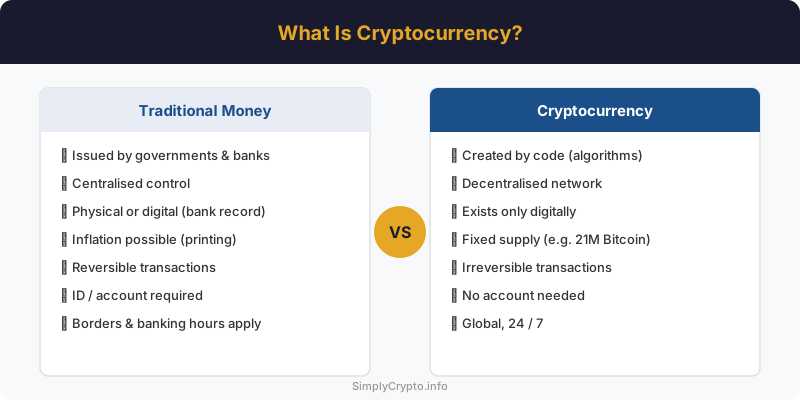
Cryptocurrency is a digital form of money secured by cryptography — the mathematical science of encoding and decoding information. Unlike the money in your bank account, which is managed by a central institution (your bank, and ultimately a central bank like the Federal Reserve), cryptocurrency operates on decentralised networks where no single entity holds authority.
The concept emerged from decades of cryptographic research. In 2008, an anonymous figure known as Satoshi Nakamoto published a whitepaper titled "Bitcoin: A Peer-to-Peer Electronic Cash System." The timing was not coincidental — the global financial crisis had just exposed significant fragility in centralised banking. Nakamoto's proposal addressed a long-standing problem in digital cash systems: how do you prevent someone from spending the same digital token twice, without trusting a central authority to track balances?
The solution was the blockchain: a distributed ledger maintained simultaneously across thousands of independent computers. Each transaction is cryptographically signed, grouped into blocks, and appended to a chain of previous blocks in a way that makes tampering computationally prohibitive. The result is a monetary system that operates through consensus rather than authority.
From an investment and utility standpoint, cryptocurrencies occupy a unique position. Some, like Bitcoin, function primarily as a store of value — a digital analogue to gold. Others, like Ethereum, power programmable financial applications. Still others are designed for privacy, speed, governance, or highly specific use cases. The practical reality varies enormously by project and use case. Bitcoin and Ethereum have built substantial ecosystems with real adoption. Many smaller tokens have not.